Paper Money Grading
International 70-point numerical scale, archival holders and public certificate lookup.
Paper Money Grading Service and Banknote Grading in India
Paper money grading assigns a condition grade to a banknote on a published scale. NAC uses the International 70-point numerical scale, seals each graded note in an archival holder, and issues a certificate that can be checked on the verify page. Also grading coins? See our coin grading service.
What Is Paper Money Grading?
Paper money grading assesses the physical condition, the printing quality and the authenticity of a banknote, then records the result on a published scale. The grade helps collectors and dealers describe a note consistently. It also helps buyers judge value without holding the note. Banknote grading is particularly important in India, where collecting older notes, error notes and replacement notes has grown steadily. A professional paper money grading service applies one standard to every note.
The International 70-Point Numerical Scale
NAC grades paper money on the International 70-point numerical scale. The scale describes a note from heavily worn to perfect uncirculated. Higher grades reflect crisp paper, sharp corners, strong colour and no folds, creases or handling marks. Each grade is assigned after the note has been checked under good light and magnification. Because the scale is standard, the grade is meaningful to buyers who have not seen the note in person.
G
Good
4, 6
VG
Very Good
8, 10
F
Fine
12, 15
VF
Very Fine
20, 25, 30, 35
XF
Extra Fine
40, 45
AUNC
About Uncirculated
50, 53, 55, 58
UNC
Uncirculated
60 to 70
The NAC Paper Money Grading Scale
Understanding the 70-Point Numerical Scale: A Foundation for Accurate Paper Money Valuation.
At NAC, we are dedicated to delivering clear, precise, and dependable paper money grading services. A key part of this commitment is our use of the internationally recognized grading scale, which provides a standard framework for evaluating the condition and value of Paper Money.
Deciphering the 70-Point Grading Scale
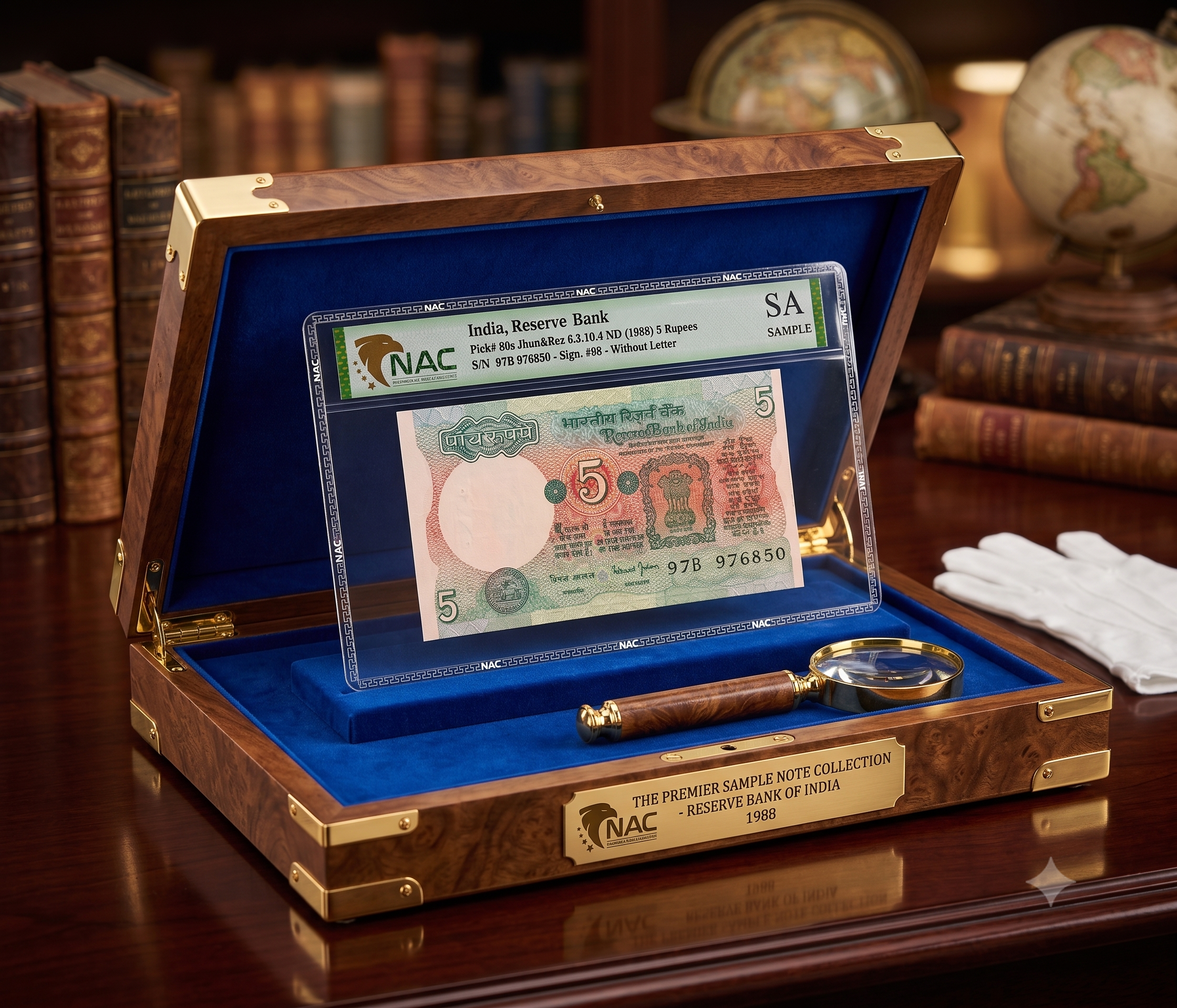
The International 70-Point Grading Scale is a numerical system for evaluating a Paper Money's physical condition. The higher the number, the better the condition of the Paper Money.
A completely flawless note with perfect centering, razor-sharp corners, deep original embossing, and absolute originality of paper surfaces. No folds, counting creases, bends, stains, foxing, pinholes, handling marks, or printing defects are visible even under magnification. The paper retains full body, natural wave, and vibrant original color with exceptional eye appeal. Margins are perfectly balanced on all sides, and the note appears exactly as issued by the printing authority. This grade is extraordinarily rare because even microscopic imperfections disqualify a note from receiving a 70 designation.
An almost perfect note with exceptional originality and superior visual quality. Centering is nearly flawless, embossing is bold, and paper brightness is fully preserved. Only the slightest microscopic imperfection prevents the note from qualifying as Gem 70. Such flaws are generally invisible without close inspection. Corners remain perfectly sharp, surfaces are pristine, and the note exhibits elite collector quality.
A virtually flawless uncirculated note with outstanding centering, excellent margins, and strong embossing throughout the paper. The note retains complete originality with no visible circulation evidence and only the tiniest handling imperfection detectable under close examination. Paper wave, brightness, and color remain exceptional, making the note highly desirable among advanced collectors.
An exceptional note with near-perfect paper quality, strong embossing, and premium eye appeal. Margins are broad and well balanced with sharp corners and fully original surfaces. Minor imperfections may exist but are extremely insignificant and difficult to locate without careful inspection. The note appears fresh, vibrant, and nearly flawless to the naked eye.
A premium quality uncirculated note with excellent centering, superior paper quality, and attractive originality. Embossing remains strong, colors are vivid, and surfaces are clean with only minimal handling evidence. Tiny counting marks or insignificant imperfections may exist but do not materially affect appearance. This grade represents a high-end collector example with outstanding visual appeal.
A fully original note with crisp paper, sharp corners, bright colors, and strong embossing. Eye appeal is exceptional with minimal distractions. Minor handling flaws such as tiny counting marks or slight centering irregularities may be present but must remain very small and unobtrusive. Gem 65 notes are considered premium investment-quality examples in the Paper Money market.
A sharply preserved note with full originality and strong paper quality. The note remains crisp with excellent color and attractive overall presentation. Minor handling marks, slight corner disturbances, or somewhat imperfect centering may be visible under inspection. Despite these small flaws, the note remains highly attractive and well above average in quality.
A fully uncirculated note with crisp paper, original embossing, and strong visual appearance. Corners remain sharp and colors bright. Light handling marks, counting flicks, or moderate centering imperfections are acceptable at this level. The note still possesses solid collector appeal and retains complete originality.
A technically uncirculated note that has never entered circulation but may show moderate handling from counting or storage. Margins may be uneven, and light corner bends or surface disturbances may be visible. Paper remains crisp and fully original with no circulation folds. Eye appeal is slightly reduced due to visible handling imperfections.
An uncirculated note with noticeable handling marks, counting bends, or poor centering that reduces overall attractiveness. The paper remains fully original and crisp, though visual distractions are more obvious than in higher UNC grades. Despite imperfections, the note has no actual circulation wear and maintains technical uncirculated status.
A strictly uncirculated note with significant handling or storage defects. Heavy counting marks, corner bumps, minor wrinkles, or uneven margins may be present. Paper originality remains intact, and no circulation folds are allowed. However, overall eye appeal is relatively weak compared to higher uncirculated grades. This grade represents the lowest level of technical uncirculated preservation.
A nearly perfect note with exceptional eye appeal and almost full uncirculated appearance. Only one very light counting crease, corner bend, or handling mark prevents a full UNC designation. Paper remains crisp with strong embossing and vibrant color. Many AU-58 notes appear visually identical to lower-grade uncirculated notes.
A lightly handled note with excellent paper quality and minimal circulation evidence. One or two faint folds or bends may be visible, usually only under angled light. Corners remain sharp, and colors stay bright and original. The note retains strong collector appeal and nearly full crispness.
A high-quality note with limited handling and excellent preservation. Minor counting bends or a single light fold may exist, though paper quality remains strong and attractive. Embossing and brightness are still very noticeable. The overall appearance remains close to uncirculated condition.
A nearly new note showing only slight evidence of handling. One vertical fold, one horizontal fold, or a few light counting creases are acceptable. Paper remains crisp and attractive with strong color and original texture. Corners remain mostly sharp with minimal wear. This grade marks the transition between circulated and uncirculated quality.
A lightly circulated note with excellent paper body and strong eye appeal. Only a few light folds or bends are visible, and the paper retains partial crispness and firmness. Colors remain vivid with relatively clean surfaces. Handling evidence is minor and does not significantly distract from presentation.
A lightly circulated note with three or fewer folds and minimal surface wear. The paper still retains some crispness and original strength, while corners show only slight rounding. Colors and design details remain sharp and attractive. This is considered a highly collectible circulated grade.
A moderately circulated note with several folds but relatively solid paper quality. The note remains clean with attractive color and limited dirt accumulation. Corners show moderate wear but remain intact. Paper body is still firm compared to lower circulated grades.
A well-circulated note with moderate folds and handling throughout the surface. Paper remains relatively firm with decent structural integrity and good overall appearance. Minor edge wear and slight dirt are acceptable. Design details remain clear and visually appealing.
A circulated note with moderate wear and several visible folds. Paper quality remains respectable, and the note retains fair eye appeal with limited staining or edge damage. Corners are rounded but not excessively worn.
A moderately circulated note with multiple folds, light dirt, and noticeable handling. Paper retains some firmness but has lost most original crispness. Small edge splits or corner wear may be present. The note remains attractive despite clear circulation evidence.
A considerably circulated note with several heavy folds and soft paper texture. Corners are rounded, and moderate dirt or discoloration may appear throughout the surface. Small edge splits are acceptable. Despite wear, the note remains complete and fully collectible.
A well-used note with numerous folds, moderate soiling, and noticeable softness in the paper. The note remains intact with all major design elements visible. Minor edge tears or pinholes may exist. Overall appearance reflects substantial circulation.
A heavily circulated note with extensive folds, limp paper, and heavy handling wear. Corners are significantly rounded, and dirt accumulation is visible across the surface. Minor tears or pinholes are acceptable. The note remains whole and fully identifiable.
A very worn note with strong circulation evidence and soft paper quality. Numerous folds, edge wear, pinholes, stains, and moderate dirt may be present. Despite heavy handling, all important design details remain visible.
A heavily circulated note with weak paper strength and major wear throughout. Corners are heavily rounded, folds are deep, and edge splits are common. Small missing pieces may exist near margins. The note remains complete enough for identification and collection.
An extremely worn note with severe circulation damage and heavy dirt accumulation. Large folds, edge tears, pinholes, and rounded corners dominate the appearance. Paper is weak but still intact. Major design elements remain visible despite extensive wear.
Banknote Grading Process at NAC
Every banknote goes through the same review.
Authenticity
When a banknote arrives at NAC, our graders first confirm it is genuine.
Examination
They then examine the paper, the printing, the margins, the corners and any folds, tears, repairs or stains.
Both sides
Papermoney are assessed from both sides, with obverse and reverse images recorded where possible.
Grade and certificate
Once graded, the note is placed in a tamper-evident holder and issued a certificate that can be looked up publicly.
Key Factors Evaluated During the Paper Money Grading Process
Paper Money grading is based on several important factors that determine a note’s condition, authenticity, and overall collectible value. Each factor is carefully examined to assign an accurate grade.
Print Quality & Eye Appeal
The clarity of printing, brightness of colors, and overall visual appeal of the note are important grading factors. Attractive notes with strong eye appeal are more valuable.
Paper Quality
The texture, strength, and originality of the paper are checked to ensure the note has not been repaired, cleaned, or chemically altered. Crisp and original paper receives higher grades.
Stains & Discoloration
Any stains, ink marks, dirt, fading, or discoloration are evaluated, can give a huge impact on the grade of the particular note. As they can affect both appearance and value.
Centering & Margins
Graders evaluate how well the design is centered on the note and whether the borders are even on all sides. Well-centered notes are generally more desirable and achieve higher grade
Tears, Holes & Damage
Experts check under a high magnifying system for surgical precision in damages such as tears, pinholes, repairs, trimming, or missing pieces, all of these matter alot in Paper Money's grade.
Corners & Edges
Sharp, clean corners and intact edges indicate minimal handling. Rounded corners, tears, or frayed edges can lower the grade.
Expert Analysis
"Every note undergoes a meticulous inspection process by our team of experienced numismatists to ensure consistency and accuracy across the entire 70-point scale."
Archival Holders That Protect Your Notes
Each graded note is sealed in a tamper-evident, archival-quality holder. The holder protects the note from handling, humidity, light and the other factors that damage paper over time. It also makes it obvious if the note has been removed or tampered with. Storing a note in a sealed holder keeps its grade stable, which is what makes the grade useful to the next buyer.
Why Collectors Choose NAC for Paper Money Grading
Collectors compare paper money grading companies on consistency, protection and transparency. NAC works from one published scale, applies it to every note, and gives each graded note a certificate that can be checked. Learn more about NAC.
The Importance of Paper Money Grading
In the field of numismatics, grading is an essential process that provides a standardized assessment of a Paper Money’s quality and genuineness. Paper Money grading ensures the authenticity, condition, and accurate market value of your currency collection. Professionally graded notes inspire collector trust, improve resale opportunities, and help preserve your investment for future generations.
Authentication & Trust
Paper Money grading verifies the authenticity of a note, protecting collectors and investors from counterfeits and altered currency. A graded note builds confidence among buyers and sellers.
Accurate Condition Assessment
Professional grading provides a standardized evaluation of a Paper Money's condition under the standard scale of 70 points that is followed globally, including factors such as wear, folds, stains, and overall preservation. This ensures fair and transparent assessment.
Historical Preservation
Tamper-proof encapsulation protects Paper Money from handling, environmental exposure, and damage that may affect their condition over time. Professional grading and secure preservation help retain the historical and cultural value of Paper Money for future collectors and researchers.
Enhanced Market Value
Graded Paper Money often command higher market prices because their quality and authenticity are officially certified. Higher grades can significantly increase a note’s collectible and investment value.
Easily Tradeable
Graded Paper Money are easier to trade in auctions, online marketplaces, and private sales because buyers can rely on an internationally accepted grading standard.
Fostering Trust
NAC professional grading services play a crucial role in the numismatic community, providing several key benefits to collectors and investors.
Paper Money Grading FAQs
What scale does NAC use for paper money?
NAC grades paper money on the International 70-point numerical scale.
Can I send any banknote for grading?
NAC grades Indian and foreign banknotes and other paper money. Contact us with the details if you are unsure whether your items qualify.
Are graded notes protected?
Yes. Each graded note is sealed in a tamper-evident, archival-quality holder that protects it from handling and the environment.
How can I check a paper money certificate?
Use the Verify Certificate page, choose Paper Money, and enter the item number and grade shown on the certificate.