Coin Grading
Sheldon 70-point scale, expert numismatists and tamper-evident holders.
Professional Coin Grading Service in India
Professional coin grading is the process of examining a coin's authenticity and condition and assigning a grade on a standard scale. NAC grades coins on the Sheldon 70-point scale, seals each coin in a tamper-evident holder and issues a certificate that can be verified online.
What Is Professional Coin Grading?
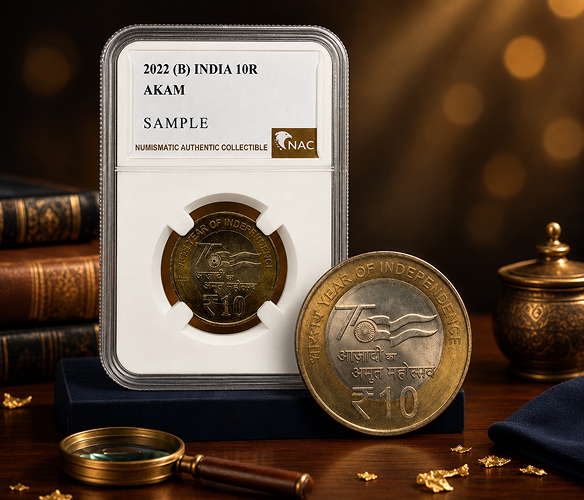
Professional coin grading is the process of examining a coin, judging its condition and authenticity, and recording the result in a grade. The grade tells a buyer what they are getting before they pay. It also protects sellers, because a clear, consistent grade supports the value of the coin. A professional coin grading service uses trained numismatists, a published scale, and a sealed holder that protects the coin after grading.
How NAC Grades a Coin
Every coin that comes to NAC goes through a structured review.
Authenticity
Our experts check authenticity first.
Condition
They then assess wear, strike, surface, lustre, marks and any signs of cleaning or repair.
Expert Examination
Each item undergoes a meticulous inspection by our experienced specialists.
Grade and certificate
The coin is then graded, encapsulated in a tamper-evident holder, and issued a certificate that can be verified online.
The Sheldon 70-Point Scale Explained
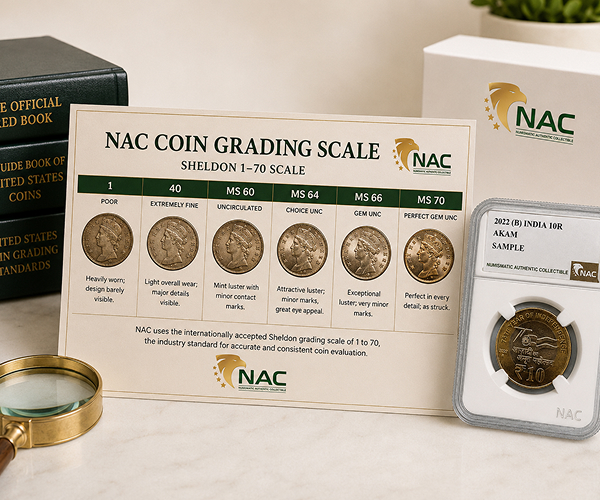
NAC coin grades follow the Sheldon 70-point scale, the scale most widely used for coins. It runs from 1 (poor, barely identifiable) to 70 (perfect, with no visible flaws under magnification). Grades in the middle of the scale describe the level of wear and the number of marks a coin carries. A higher number means a cleaner coin with sharper detail. Because the scale is standard, a grade from NAC can be compared with grades from other providers that use the same scale.
PO
Poor
1
FR
Fair
2
AG
About Good
3
G
Good
4, 6
VG
Very Good
8, 10
F
Fine
12, 15
VF
Very Fine
20, 25, 30, 35
XF
Extremely Fine
40, 45
AU
About Uncirculated
50, 53, 55, 58
MS/PF
Mint State / Proof
60 to 70
NAC Coin Grading Scale
NAC employs the widely recognized Sheldon grading scale, which ranges from 1 to 70 and was first introduced in the United States in the late 1940s. When NAC commenced operations in 2026, it adopted this system, which is now regarded as the standard across the industry.
What is a 70?
A Mint State or Proof 70 coin has no post-production imperfections at 5× magnification.
Scale Range
Numeric grades range from 1 (barely identifiable) to 70 (perfect), with MS 60+ being Uncirculated.
Industry Standard
Sheldon 1–70 Scale
Strike Types
Two Letter short code is used by NAC to define the strike of a particular coin, moreover it tells the overall appearance and production method.
Strike Type
Mint State
Achieved only to coins with grades 60-70.
Strike Type
Proof
Typically minted for collectors and are not intended for general circulation.
Strike Type
Specimen
Distinct type of coin production that falls between standard circulation coins and fully proof-issued coins.
Numeric Grades
NAC assigns a numerical grade to clearly indicate the condition of a problem-free coin. These grades run from 1 to 70, following the internationally recognized Sheldon grading scale developed in the 1940s. Higher numbers represent better coin condition. Below grade 60 (the cutoff for Uncirculated coins), certain numbers are not used.
A coin with no post-production imperfections at 5x magnification.
A fully struck coin with nearly imperceptible imperfections.
Very sharply struck with only miniscule imperfections.
Sharply struck with only a few imperfections.
Very well struck with minimal marks and hairlines.
Well struck with moderate marks or hairlines.
Average or better strike with several obvious marks or hairlines and other miniscule imperfections.
Slightly weak or average strike with moderate abrasions and hairlines of varying sizes.
Slightly weak or average strike with no trace of wear. More or larger abrasions than an MS/PF 63.
Weak or average strike with no trace of wear. More marks and/or multiple large abrasions.
Weak or average strike with no trace of wear. Numerous abrasions, hairlines and/or large marks.
Slight wear on the highest points of the design. Full details.
Slight wear on less than 50% of the design. Full details.
Slight wear on more than 50% of the design. Full details except for very minor softness on the high points.
Slight wear on more than 50% of the design. Full details except for minor softness on the high points.
Complete details with minor wear on some of the high points.
Complete details with minor wear on most of the high points.
Complete details with wear on all of the high points.
Nearly complete details with moderate softness on the design areas.
Nearly complete details with more softness on the design areas.
Moderate design detail with sharp letters and digits.
Recessed areas show slight softness. Letters and digits are sharp.
Recessed areas show more softness. Letters and digits are sharp.
Wear throughout the design. Letters and digits show softness.
Wear throughout the design. Letters and digits show more softness.
Peripheral letters and digits are full. Rims are sharp.
Peripheral letters and digits are nearly full. Rims exhibit wear.
Most letters and digits are readable. Rims are worn into the fields.
Some details are visible. Rims are barely visible.
Enough detail to identify the coin's date and type. Rims are flat or nearly flat.
* Adjectival grades may be assigned by NAC for bulk submissions of common coins instead of numeric grades.
Plus Designation
NAC uses the Plus (+) designation to identify coins at the high end of their assigned grade and/or with exceptional eye appeal for their assigned grade. All coins are evaluated for the Plus designation as part of the standard NAC grading process, and it is assigned automatically at no additional fee.
NAC Designation
Plus (+)
NAC assigns a + to coins at the high end of their assigned grade, approaching the quality requirements for the next grade. For example, a coin graded NAC MS 64+ is close to the quality of a coin graded NAC MS 65.
In addition to their superior technical merit, coins that receive a + must have above-average eye appeal.
Not all coins are eligible for +. Coins grading from NAC XF 45 to NAC MS 68 or NAC PF 45 to NAC PF 68 may receive a +, while lower- and higher-grade coins cannot.
The + is assigned when merited to coins from the earliest issues to date, excluding bullion and modern commemorative coins, and to world coins struck prior to 1970.
Coins are automatically evaluated for + during grading. Coins must be submitted for grading to be reviewed for this designation.
Strike Characters
Strike characters are used to indicate the quality of a coin’s strike, especially when certain details are of particular interest to collectors. For instance, they may denote the level of red luster on a copper coin’s surface (BN, RB, RD), the amount of contrast on a proof coin (Cameo, Ultra Cameo), or highlight specific features such as FB (Full Bands) on a Mercury Dime.
Example
A copper Anna graded MS 65 RD is Mint State with grade 65 and has full mint red luster.
Red
A coin with full mint red luster.
Red Brown
A coin with a mix of red luster and brown patina.
Brown
A coin with full or nearly full brown patina.
Ultra Cameo
Applies only to PF coins. The fields are deeply mirrored and the devices are heavily frosted for bold contrast on both sides of the coin.
Cameo
Applies only to PF coins. The fields are deeply mirrored and the devices are frosted for moderate contrast on both sides of the coins.
Deep Prooflike
The fields are deeply mirrored. Does not apply to Proof coins.
Prooflike
The fields are mirrored. Does not apply to Proof coins.
Why Choose NAC Among Coin Grading Companies
Buyers compare coin grading companies on accuracy, consistency and protection. NAC's approach is built on three points. Grading uses a published scale and the same standard for every coin. Each item is reviewed under magnification and checked by more than one specialist where needed. Graded coins are sealed in archival-quality, tamper-evident holders to protect them from handling and the environment. Learn more about NAC.
Coins, Tokens, Medals and Bullion We Grade
NAC's coin grading covers circulating coins, colonial and historical coins, error coins, tokens, medals and bullion pieces. If you are not sure whether your item qualifies, contact us and describe it. We will confirm whether it is suitable and what the next steps would be.
Coin Grading FAQs
What is the difference between coin grading and coin authentication?
Authentication confirms whether a coin is genuine. Grading goes further and assigns a condition grade on a standard scale, so the coin's value can be compared with others of the same type.
What scale does NAC use for coins?
NAC grades coins on the Sheldon 70-point scale, which runs from 1 to 70.
Which coins can I send to NAC?
NAC grades coins, tokens, medals and bullion pieces. Contact us if you have an item that does not fit these categories.
Does NAC offer conservation for coins?
Yes. Conservation stabilises a coin before it is sealed in a holder. It does not restore or alter the coin.
How do I check an NAC coin certificate?
Use the Verify Certificate page and enter the item number and grade from the certificate.